

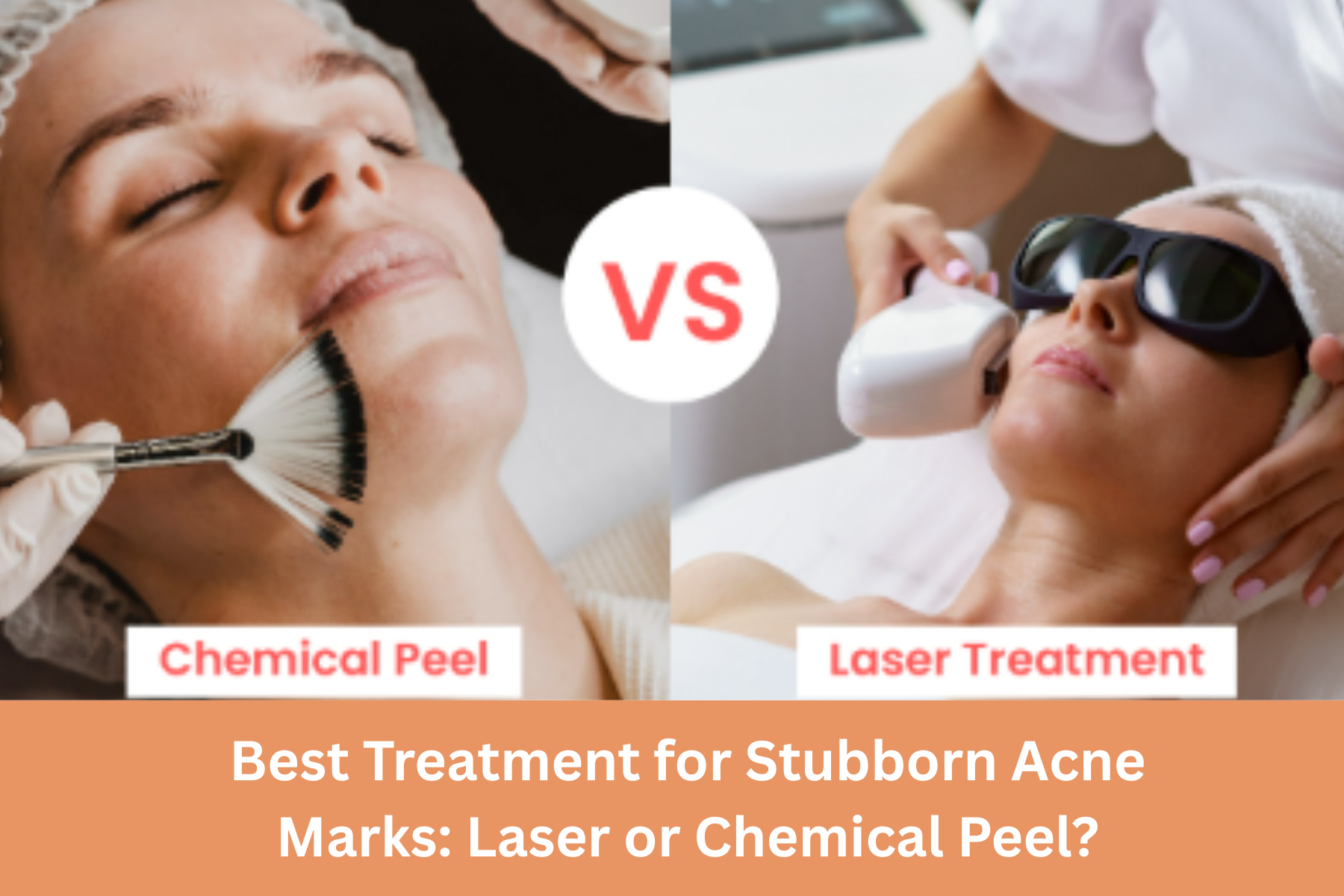
If you are struggling with stubborn acne marks, we understand how frustrating that can feel. Even after active acne settles down, the reminders stay in the form of dark spots, red marks, or uneven skin texture.
One of the most common questions we hear in the clinic is, “Doctor, what is the Best Treatment for Acne Marks: Laser or Chemical Peel?” The honest answer is: it depends on your type of marks, your skin type, and how deep the damage is. Let’s walk through this together so you can make a confident, informed decision.
Know Your Acne Marks
Before we decide on the best treatment, we need to understand what type of acne marks you have. Not all marks are the same, and that’s where most confusion begins.
1. Post-Inflammatory Hyperpigmentation (PIH)
These are brown or dark spots left behind after acne heals. They are common in Indian skin and tend to worsen with sun exposure.
2. Post-Inflammatory Erythema (PIE)
These appear as pink or red marks. They are more vascular in nature and not pigment-based.
3. Atrophic Acne Scars
These are depressed scars where collagen loss has occurred:
- Ice-pick scars (deep, narrow)
- Boxcar scars (wider, defined edges)
- Rolling scars (uneven texture)
Now here’s the key:
- Pigmentation marks respond well to surface treatments.
- Depressed scars need collagen stimulation.
That’s why the Best Treatment for Acne Marks depends entirely on what you’re treating.
Chemical Peel for Acne Marks: How It Works
Let’s first talk about Chemical Peel for Acne Marks, because many patients start here.
What is a Chemical Peel? A chemical peel involves applying a medical-grade solution that gently exfoliates the upper layers of your skin. As that damaged layer sheds, new, healthier skin replaces it. Think of it as controlled skin renewal.
Who Benefits Most from Chemical Peels?
We usually recommend Chemical Peel for Acne Marks if you have:
- Brown pigmentation (PIH)
- Uneven skin tone
- Mild texture irregularities
- Oily or acne-prone skin
- Early, superficial scars
Peels work best when the problem is on the surface.
How Chemical Peels Improve Acne Marks
They help by:
- Speeding up cell turnover
- Lightening pigmentation
- Improving overall skin glow
- Reducing mild textural roughness
- Preventing new acne breakouts (in some peel types)
Over 4–6 sessions, spaced 3–4 weeks apart, you may notice gradual fading of marks.
Downtime and Recovery
Most superficial peels involve:
- Mild redness
- Light peeling for 2–5 days
- Minimal disruption to routine
Medium-depth peels may require slightly more downtime. If you are looking for a lower-cost, lower-downtime option, peels can be a good starting point.
Limitations of Chemical Peels
Here’s where we need to be honest.
Chemical peels:
- Cannot correct deep acne scars
- Cannot significantly improve collagen loss
- Work slowly for stubborn marks
If your scars are deep or pitted, this may not be the Best Treatment for Acne Marks for you.
Laser Treatment for Acne Marks: A Deeper Approach
Let’s talk about laser treatment for Acne Marks, especially for stubborn or textured scars.
What Does Laser Treatment Do?
Laser treatment works by creating controlled micro-injuries in the skin, stimulating collagen production. That new collagen helps:
- Lift depressed scars
- Smooth uneven texture
- Reduce pigmentation
- Improve skin thickness
This is not just surface exfoliation. It works from within.
Types of Laser Treatments Used
Depending on your skin and scar depth, we may use:
- Fractional CO₂ Laser
- Erbium Laser
- Non-ablative fractional lasers
Each type varies in intensity, downtime, and results.
Who is the Ideal Candidate for Laser Treatment?
Laser Treatment for Acne Marks is usually ideal if you have:
- Deep ice-pick scars
- Boxcar scars
- Rolling scars
- Long-standing stubborn acne marks
- Poor response to creams and peels
If texture is your main concern, laser often delivers better results than peels.
Downtime and Recovery
Laser treatments may involve:
- Redness for 3–7 days
- Mild swelling
- Temporary darkening before improvemen
You may need 3–5 sessions, depending on severity. Yes, it’s more intensive. But also more powerful.
Laser vs Chemical Peel: Best Treatment for Acne Marks
Let’s compare clearly:
| Factor | Chemical Peel | Laser Treatment |
| Best for | Pigmentation & mild marks | Deep scars & texture |
| Depth of action | Surface | Deeper dermal layers |
| Downtime | Minimal | Moderate |
| Collagen stimulation | Mild | Strong |
| Sessions needed | 4–6+ | 3–5 |
| Cost per session | Lower | Higher |
| Results for deep scars | Limited | Significant |
Now ask yourself:
- Are your marks flat and dark? Peels may be enough.
- Are your scars indented or textured? Laser is likely better.
There is no one-size-fits-all answer. The Best Treatment for Acne Marks depends on your skin.
What About Indian Skin Types?
This is extremely important. Indian and darker skin types are more prone to:
- Post-inflammatory hyperpigmentation
- Sun sensitivity
- Pigment rebound if treatments are too aggressive
That’s why we always individualise:
- Gentle peel strengths
- Proper laser settings
- Pre- and post-treatment pigmentation control
- Strict sunscreen use
Safety matters just as much as results.
Can We Combine Laser and Chemical Peels?
Yes, and sometimes, that’s the real game changer. In stubborn cases, we may:
- Use peels first to reduce pigmentation
- Follow with laser to improve texture
- Alternate sessions strategically
Combination therapy often delivers better overall improvement than using just one treatment. When patients ask us about the Best Treatment for Acne Marks, we often say: sometimes it’s not ‘either-or’, but ‘both in the right sequence.
What Results Can You Realistically Expect?
Let’s set realistic expectations.
- Pigmentation marks may improve 60–80% with proper treatment.
- Mild scars improve gradually over months.
- Deep scars improve significantly but rarely disappear 100%.
Collagen remodelling takes time. Improvement continues for 3–6 months after laser sessions. Consistency and sun protection are crucial.
What You Should Not Ignore
Before choosing your treatment, keep this in mind:
- Active acne must be controlled first.
- Sun protection is non-negotiable.
- Treatment strength must match your skin tolerance.
- DIY or salon procedures can worsen scars permanently.
Always consult a qualified dermatologist before starting Laser Treatment for Acne Marks or Chemical Peel for Acne Marks.
So, What Is the Best Treatment for Acne Marks?
Here is our honest answer:
- If your concern is pigmentation and mild marks, start with a Chemical Peel for Acne Marks.
- If your concern is deep scars and texture, Laser Treatment for Acne Marks is usually more effective.
- If your scars are mixed. A customised combination approach may give you the best results.
Best Treatment for Acne Marks is not about trends or social media recommendations. It’s about choosing what your skin actually needs. And that decision should always be made after examining your scars closely. Not simply just through a photo or assumption.
Final Advice
If acne marks are affecting your confidence, please know this: they are treatable. Improvement is possible. But patience, proper diagnosis, and realistic expectations are key. We don’t chase “instant perfection”. We focus on safe, gradual, visible improvement.
If you’re unsure whether Laser Treatment in Delhi for Acne Marks or Chemical Peel for Acne Marks is right for you, the best first step is a professional skin assessment.
Bbeauters Aesthetic Clinic is Delhi’s trusted destination for advanced skin, laser, and aesthetic treatments, delivering personalised care and visible results. Book your appointment today.